
Let’s say you manage a packaging plant near Monterrey. A big export order lands on Tuesday, two operators call in sick, and a vendor swears they can send thirty people by Friday. Tempting? Sure. Safe? Not so fast. Since 2021, Mexico has banned most deals where one company simply lends workers to another, and buyers who look the other way can end up sharing the blame. Short-term hiring is still perfectly legal and quite common, though. You just need an honest job description, a proper written contract, social security from day one, and a partner who can show real, current paperwork. Inspections are getting tougher, wages keep climbing, and the workweek is about to shrink in steps. None of that is a reason to panic. It’s a reason to plan. In this blog, we will discuss how short-term hiring works in Mexico and what employers should check before they commit.
Why the Old Shortcut Stopped Working
Before 2021, plenty of Mexican companies moved their staff onto the payroll of a separate firm. Costs dropped, and so did the profit share workers would normally receive. Lawmakers weren’t amused. Personnel outsourcing is now prohibited. What remains is a much smaller lane. An outside partner can help you find and screen candidates, or it can carry out a specialized job outside your core business, using its own employees on its own payroll. What it can’t do is hand you a crew for your everyday operations. That’s why, when you compare any temporary staffing services in Mexico partner, price shouldn’t be your first question. Ask who the legal employer is. Ask whether they’re on the federal registry for specialized providers. If the answers come quickly and clearly, good. If you get a lot of hand-waving, take that as your answer.
The Legal Lines You Can’t Blur
A fixed-term contract makes sense when the work really is short by nature. A holiday rush qualifies. So does a single project, or covering for someone on parental leave. In every case, put the contract in writing, state the reason for the limited term, and describe the real duties. Labeling a year-round job as temporary is a bad idea, because it’s the first thing an inspector will question. Specialized providers also need a place on the labor ministry’s registry, and enforcement has teeth. A late 2025 inspection protocol targets illegal subcontracting, missing registrations, and fake specialized services. It isn’t easy for providers, either. One industry report from January 2026 found that only about 53% of them managed to renew. In June, the ministry cut some of the paperwork for registration and renewal, although the underlying duties stayed put. Simpler forms, same responsibility.
From Request to First Shift
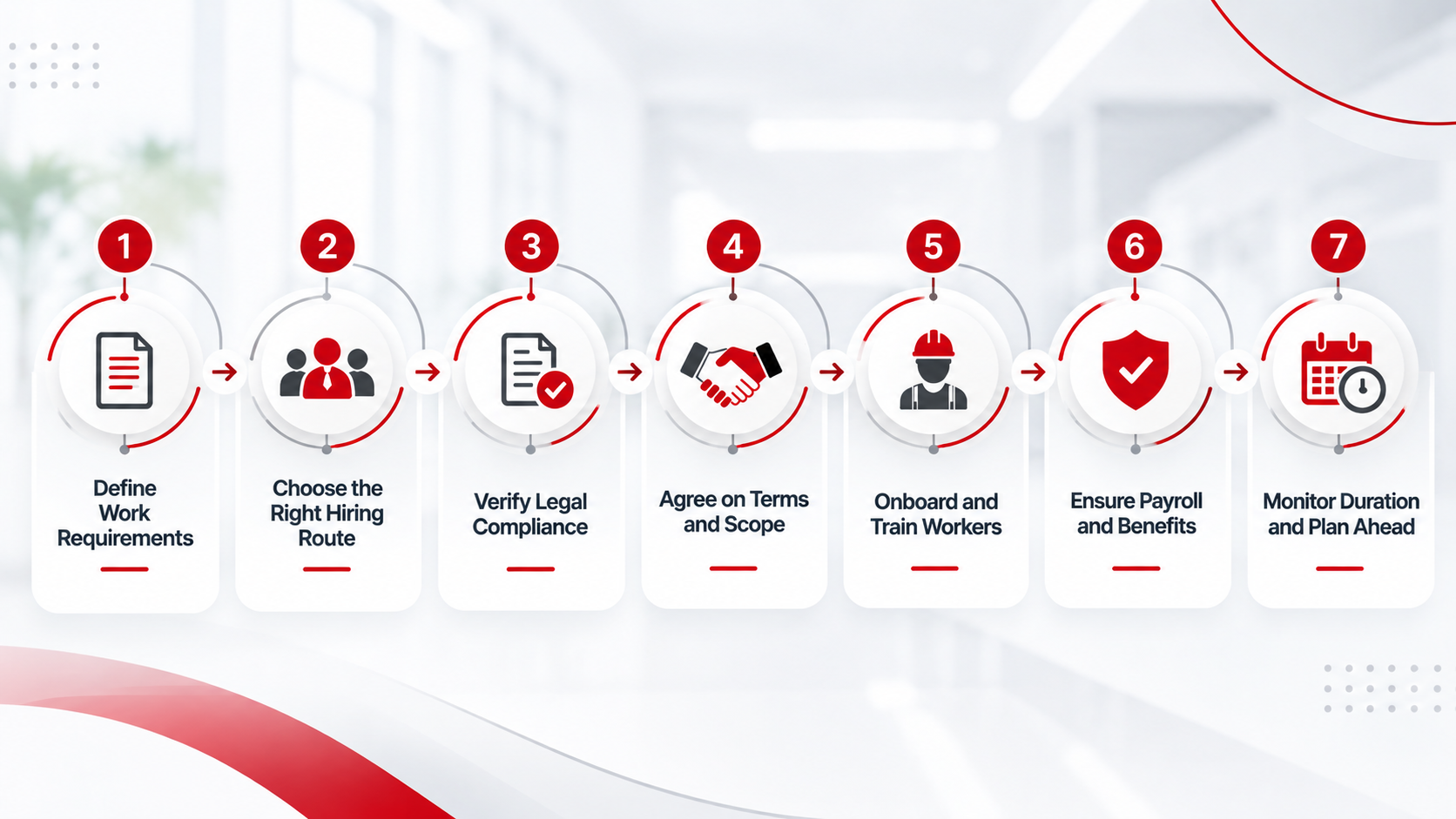
- Start with a simple list: which tasks, which dates, how many people.
- Choose your route: direct fixed-term hiring, or a registered provider for specialized work.
- Ask for documents before you ask for quotes: registry status, tax filings, social security payments.
- Spell out scope, length, and who supervises the daily work in the agreement.
- Enroll each worker in social security before the first shift, not after.
- Give a real safety briefing, even if the job lasts two weeks.
- Log hours electronically and pay on the agreed date.
- Put the end date in your calendar so nobody drifts past it.
The Costs That Catch People Off Guard
Wages are only the opening bid, and the floor keeps rising. The general daily minimum wage went up 13% on January 1, 2026, from 278.80 to 315.04 pesos. On top of pay, you’ll cover social security contributions, proportional vacation, a vacation bonus, and a year-end bonus worth at least 15 days of pay, all prorated to time worked. Profit sharing can apply too, and regulators have been looking harder at underreported profit sharing. Then there’s the calendar. The legal workweek falls from 48 hours to 40 in two-hour steps between 2027 and 2030, with no cut in pay. Electronic attendance tracking is now mandatory. So when quotes arrive from temporary staffing solutions in Mexico vendors, ask them to list wages, contributions, and fees on separate lines. A suspiciously low price usually means a cost is hiding somewhere, and it tends to land on your desk later.
Small Habits, Fewer Headaches
Think of compliance as housekeeping, not heroics. Keep contracts, registry proof, pay slips, and training records in one shared folder, so nothing lives only in one person’s inbox. Check that what workers do all day matches what’s written on paper, because that’s exactly what inspectors compare. Hold temporary staff to the same safety and conduct standards as everyone else. Look at end dates a few weeks early; an expired agreement with someone still on the floor is an easy and expensive slip. And once a year, book a short review with a local labor lawyer or accountant. It costs far less than a fine, and you’ll sleep better.
Before You Sign Anything
Short-term hiring in Mexico isn’t off limits. It doesn’t work the way it did five years ago. Before you sign with anyone, find out who the legal employer is, and treat a fuzzy answer as a no. Keep contracts honest. If the job runs all year, don’t call it temporary. Ask for registry proof and social security records up front, and insist that quotes break out wages, contributions and fees. Budget for rising pay, since the minimum wage jumped 13% this year and the workweek keeps shrinking until 2030. Then store your paperwork in one place and let a local labor lawyer glance over it each year. It costs little, and it saves you a fine or a bad surprise.
Frequently Asked Questions
1. Can a staffing company in Mexico lend workers to my business?
Not in the old way, since the labor reform banned lending personnel. A provider can still help you recruit or run a specialized service with its own registered staff.
2. How long can a fixed-term contract last?
It lasts as long as the project, season, or replacement need does, with no set number of months. If the job keeps going, you can extend it, but never label a permanent role as temporary.
3. Do temporary workers get benefits?
Yes, they need social security from their first day, plus prorated vacation, a vacation premium, and a year-end bonus. Skipping these is a quick way to land fines and back pay.
4. What should I check before choosing a provider?
Ask for registry proof, current tax and social security payments, and a written contract that names the exact service. A reliable partner answers openly and never rushes you to sign.
5. Who is responsible if a provider breaks the rules?
Often both sides, because authorities can hold the company receiving the work jointly liable. Vet partners carefully, keep every record, and get a local labor adviser to review things each year.
